News Column

Entering the Realm of Atomic-Level Mechanisms
GLOCAL ECONOMYApril 2026

Entering the Realm of Atomic-Level Mechanisms

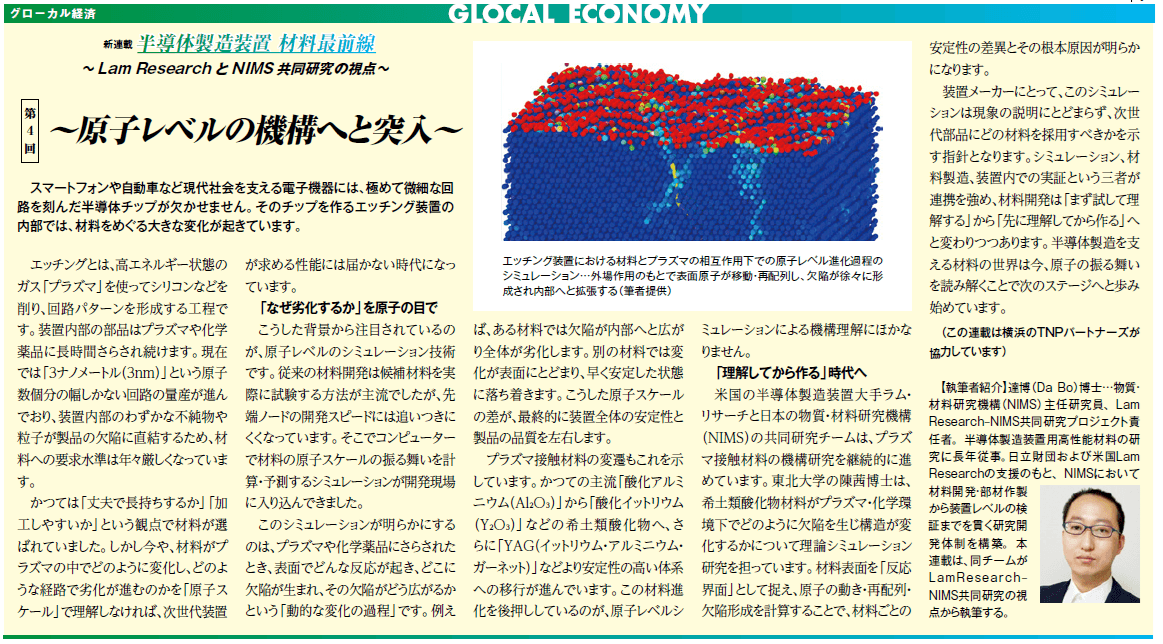
Electronic devices that support modern society, such as smartphones and automobiles, rely on semiconductor chips engraved with extremely fine circuits. Inside the etching equipment used to manufacture these chips, major changes regarding materials are taking place. Etching is a process that uses "plasma," a high-energy gas, to carve away silicon and other materials to form circuit patterns. Components inside the equipment are continuously exposed to plasma and chemicals for extended periods. Currently, with the mass production of "3 nanometer (3nm)" circuits—which are only a few atoms wide—underway, even minor impurities or particles inside the equipment can directly lead to product defects. Consequently, the standards required for materials are becoming stricter each year. In the past, materials were selected based on criteria such as "durability" and "ease of processing." Now, however, we have entered an era where failing to understand at the "atomic scale" how materials change within the plasma and the pathways through which degradation progresses means falling short of the performance required by next-generation equipment. ——Viewing "Why Degradation Occurs" Through an Atomic Lens Against this backdrop, atomic-level simulation technology is attracting attention. Traditional material development primarily relied on physically testing candidate materials, but this approach struggles to keep pace with the development speed of advanced nodes. Thus, simulations that use computers to calculate and predict the atomic-scale behavior of materials have found their way into the development site. What these simulations reveal is the "dynamic process of change"—what reactions occur on the surface, where defects originate, and how those defects spread when exposed to plasma or chemicals. For example, in one material, defects may spread inward, causing the entire structure to degrade. In another, changes may remain on the surface, quickly settling into a stable state. These atomic-scale differences ultimately determine the overall stability of the equipment and the quality of the product. The evolution of plasma-contact materials also illustrates this. There is an ongoing transition from the formerly mainstream "aluminum oxide" to rare-earth oxides like "yttrium oxide" and further to more highly stable systems such as "YAG (yttrium aluminum garnet)." What drives this material evolution is precisely the mechanistic understanding gained through atomic-level simulations. ——Moving Towards the Era of "Understand Before Making" A joint research team from major US semiconductor equipment manufacturer Lam Research and Japan's National Institute for Materials Science (NIMS) is continuously advancing mechanistic research on plasma-contact materials. Dr. Qian Chen of Tohoku University is leading theoretical simulation research on how rare-earth oxide materials develop defects and undergo structural changes in plasma and chemical environments. By treating the material surface as a "reaction interface" and calculating atomic movement, rearrangement, and defect formation, the differences in stability among materials and their root causes are revealed. For equipment manufacturers, this simulation goes beyond merely explaining phenomena; it serves as a guideline indicating which materials should be adopted for next-generation components. As the coordination among simulation, material manufacturing, and in-equipment verification strengthens, material development is shifting from "try first, understand later" to "understand first, make later." By deciphering atomic behavior, the world of materials supporting semiconductor manufacturing is now taking its first steps into the next stage. (This series is supported by TNP Partners in Yokohama)
Materials Define the Apparatus — The Changing Role of Materials
GLOCAL ECONOMYApril 2026

Materials Define the Apparatus — The Changing Role of Materials

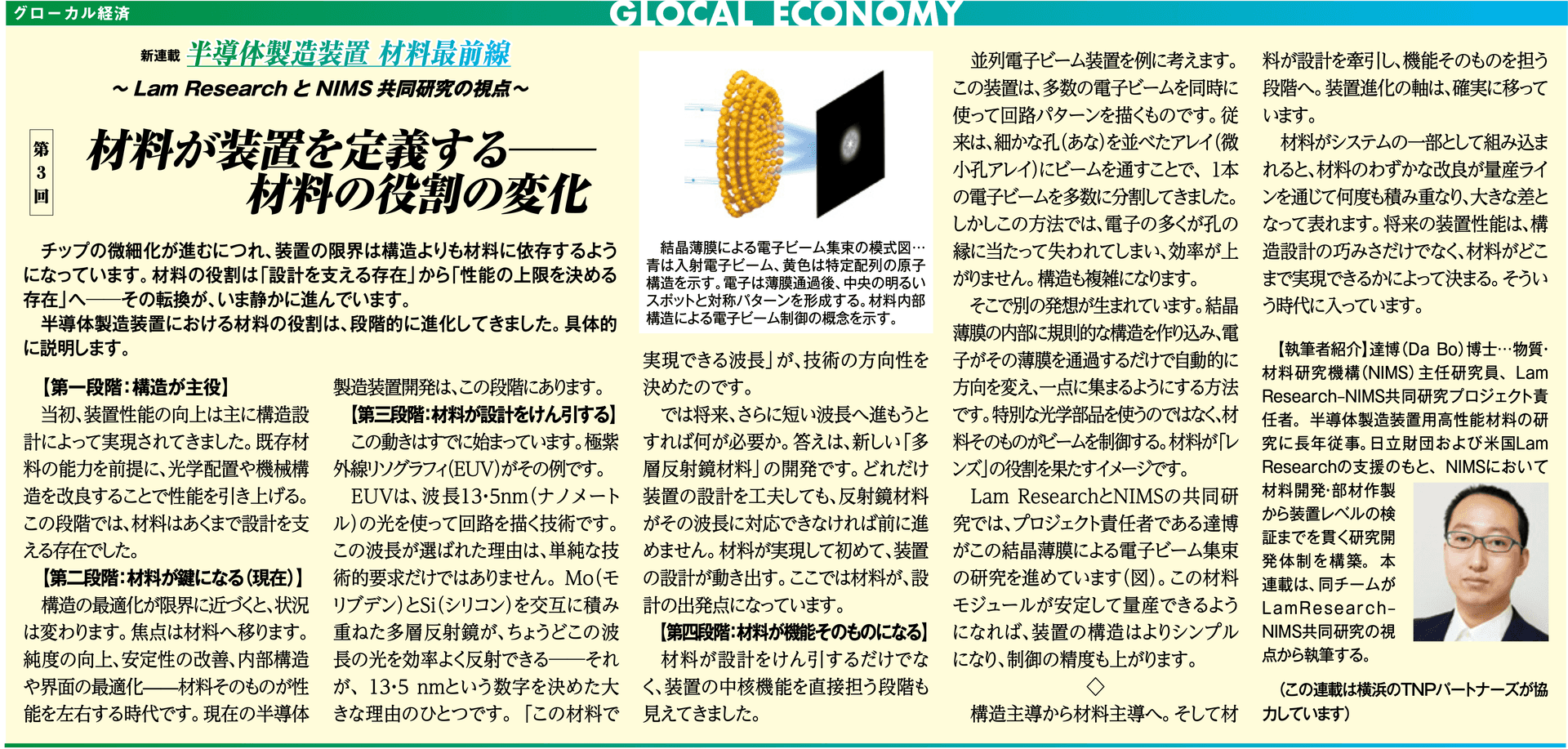
As chip miniaturization progresses, the limits of equipment are becoming more dependent on materials than on structure. The role of materials is shifting from "supporting the design" to "determining the upper limit of performance" – a transition that is quietly underway. The role of materials in semiconductor equipment has evolved in stages, as explained below. ——[Stage 1: Structure as the Protagonist] Initially, improvements in equipment performance were mainly achieved through structural design. Performance was enhanced by refining optical layouts and mechanical structures, predicated on the capabilities of existing materials. In this stage, materials were merely an existence that supported the design. ——[Stage 2: Material Becomes the Key (Present)] As structural optimization approaches its limits, the situation changes. The focus shifts to materials. This is an era where the material itself—through increased purity, improved stability, and optimization of internal structures and interfaces—dictates performance. Current semiconductor equipment development is in this stage. ——[Stage 3: Material Drives Design] This movement has already begun. Extreme Ultraviolet Lithography (EUV) is an example. EUV is a technology that draws circuits using 13.5 nm (nanometer) wavelength light. The reason this wavelength was chosen was not just due to simple technical requirements. A major reason for deciding on the 13.5 nm figure is that multilayer mirrors, made by alternately stacking Molybdenum (Mo) and Silicon (Si), can efficiently reflect light at exactly this wavelength. The "wavelength achievable with this material" determined the direction of the technology. In the future, what will be needed to move toward even shorter wavelengths? The answer is the development of new "multilayer mirror materials." No matter how much one refines the equipment design, if the mirror material cannot support that wavelength, no progress can be made. Equipment design only begins to move forward once the material is realized. Here, the material becomes the starting point of the design. ——[Stage 4: Material Becomes the Function Itself] We are now seeing a stage where materials not only drive design but also directly take on the core functions of the equipment. Take parallel electron beam (EB) equipment as an example. This apparatus draws circuit patterns using multiple electron beams simultaneously. Conventionally, a single electron beam was split into many by passing it through an array of fine apertures (micro-aperture array). However, in this method, many electrons are lost by hitting the edges of the holes, hindering efficiency and complicating the structure. Hence, a different idea was born: creating a regular structure within a crystal thin film so that electrons automatically change direction and converge at a single point just by passing through the film. Instead of using special optical components, the material itself controls the electron beam. The concept is for the material to play the role of a "lens." In the joint research between Lam Research and NIMS, project leader Dr. Bo Da is advancing research on this electron beam focusing using crystal thin films (Figure). If this material module can be stably mass-produced, equipment structures will become simpler and control precision will increase. From structure-led to material-led. And then toward the stage where materials drive design and handle the functions themselves. The axis of equipment evolution is steadily shifting. When a material is integrated as part of a system, slight improvements in the material accumulate repeatedly through mass production lines, resulting in a significant difference. Future equipment performance will be determined not only by the ingenuity of structural design but also by how far the materials can go. We have entered such an era.

From Transistors to Key Materials
GLOCAL ECONOMYMarch 2026

From Transistors to Key Materials

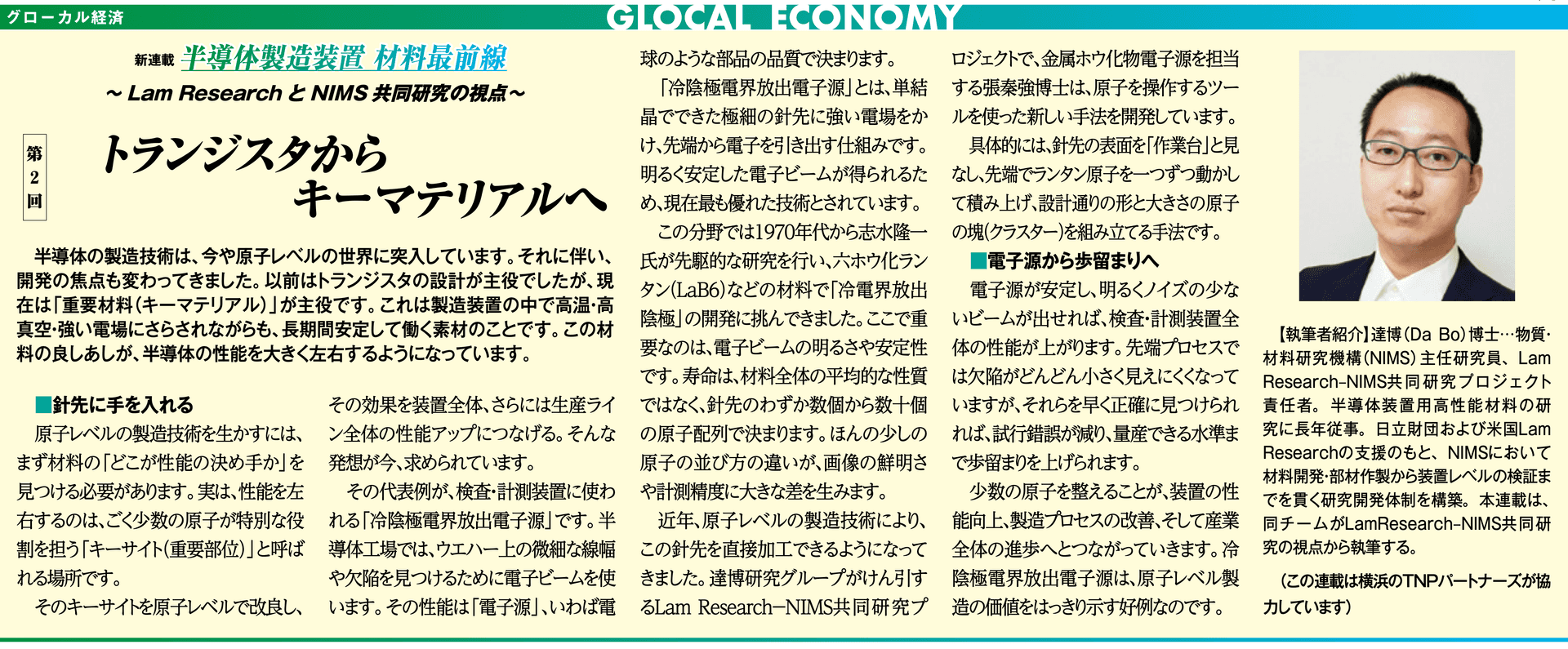
Semiconductor manufacturing technology has now entered the realm of the atomic level. Along with this shift, the focus of development has changed. Previously, transistor design played the leading role, but today, "Key Materials" have taken center stage. These are materials that must operate stably over long periods within manufacturing equipment, even while exposed to high temperatures, high vacuums, and intense electromagnetic fields. The quality of these materials now significantly dictates semiconductor performance. ——Manipulating the Needle Tip To leverage atomic-level manufacturing technology, one must first identify exactly "where the performance is determined" within a material. In fact, performance is governed by what are called "Key Sites"—specific locations where a very small number of atoms play a specialized role. There is a growing demand for a mindset that improves these key sites at the atomic level to enhance the performance of the entire equipment and, by extension, the entire production line. A prime example is the "Cold Field Emission (CFE) Electron Source" used in inspection and metrology equipment. In semiconductor factories, electron beams are used to detect minute line widths and defects on wafers. The performance depends on the quality of the "electron source," which functions much like a light bulb component. A CFE electron source works by applying a strong electric field to an extremely fine needle tip made of a single crystal to extract electrons. It is considered the superior technology today because it provides a bright and stable electron beam. In this field, Ryuichi Shimizu conducted pioneering research starting in the 1970s, challenging the development of "Cold Field Emission Cathodes" using materials such as Lanthanum Hexaboride (LaB₆). The crucial point here is that the brightness, stability, and lifespan of the electron beam are not determined by the average properties of the bulk material, but by the atomic arrangement of just a few to several dozen atoms at the very tip of the needle. Even a slight difference in how these atoms are aligned creates a massive disparity in image clarity and measurement precision. In recent years, atomic-level manufacturing technology has made it possible to process these needle tips directly. In the Lam Research–NIMS joint research project led by Dr. Da Bo's research group, Dr. Taiqiang Zhang, who is in charge of metal boride electron sources, is developing a new method using atomic manipulation tools. Specifically, the surface of the needle tip is treated as a "workbench," where lanthanum atoms are moved and stacked one by one at the tip to assemble an atomic cluster of a precisely designed shape and size. ——From Electron Sources to Improved Yield If the electron source is stable and can emit a bright, low-noise beam, the performance of the entire inspection and metrology system improves. In advanced processes, defects are becoming increasingly small and difficult to see; however, finding them quickly and accurately reduces trial and error and raises the yield to mass-production levels. Organizing just a few atoms leads to better equipment performance, improved manufacturing processes, and progress for the entire industry. The CFE electron source is a perfect example that clearly demonstrates the value of atomic-level manufacturing.

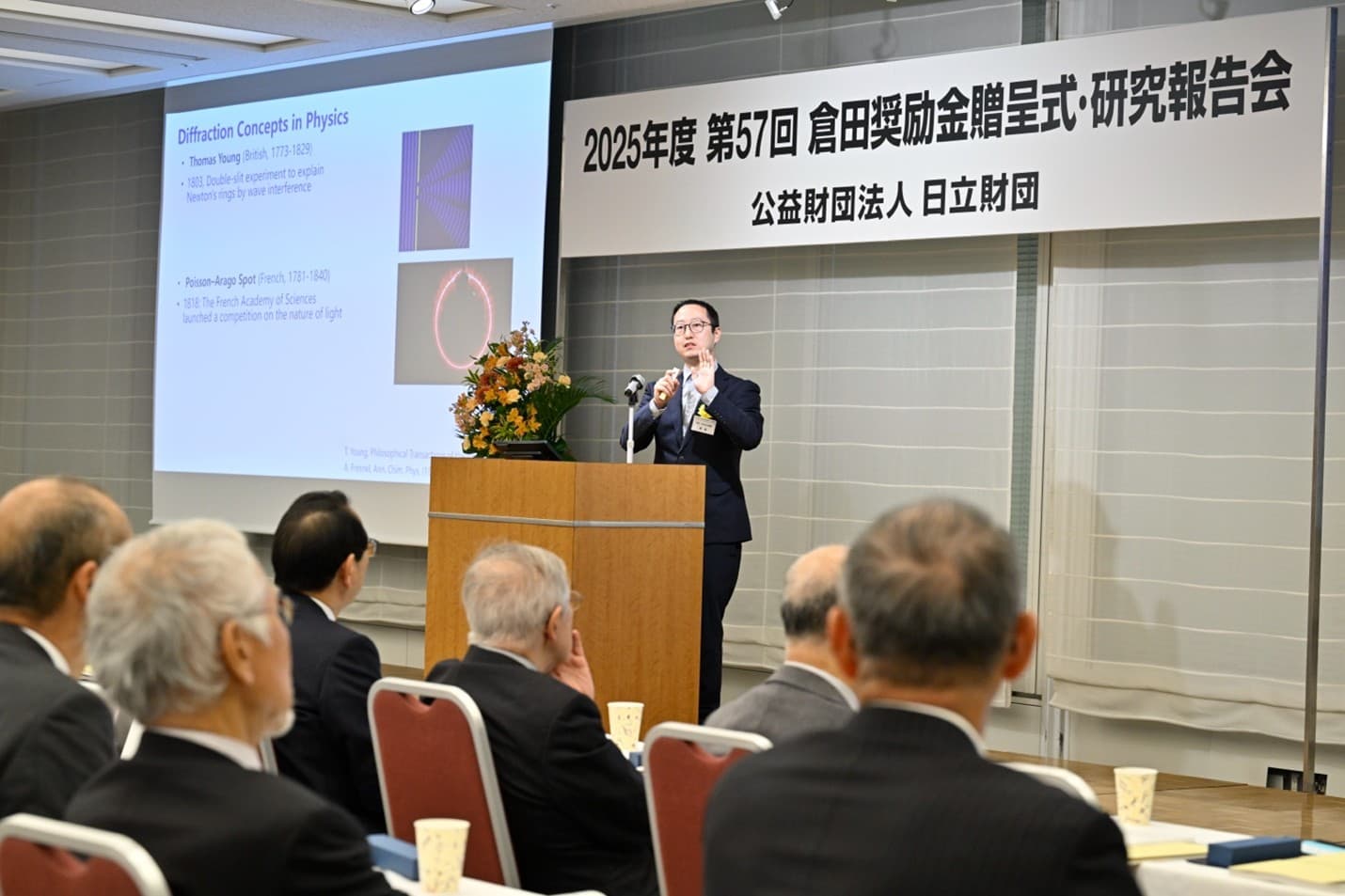
Dr. Bo Da of NIMS Present Latest Advancements in Key Materials for Semiconductor Electron Beam Equipment at the Hitachi Foundation Report Meeting
Research Presentation Meeting of The Hitachi Global FoundationMarch 2026

Dr. Bo Da of NIMS Present Latest Advancements in Key Materials for Semiconductor Electron Beam Equipment at the Hitachi Foundation Report Meeting

On March 2, 2026, Dr. Bo Da from the National Institute for Materials Science (NIMS) was invited to give a presentation at the Kurata Grant Research Report Meeting organized by the Hitachi Foundation. In his talk, he introduced recent research progress on key functional materials for semiconductor electron-beam instruments. The presentation highlighted a novel crystalline thin-film material with rotationally symmetric orientation structures and discussed its potential applications in electron-beam focusing, electron optical devices, and next-generation microfocus X-ray sources. This work provides new material and physical foundations for the development of advanced electron-beam instruments.

The Era Where "Equipment Materials" Hold the Key to Miniaturization
GLOCAL ECONOMYFebruary 2026

The Era Where "Equipment Materials" Hold the Key to Miniaturization

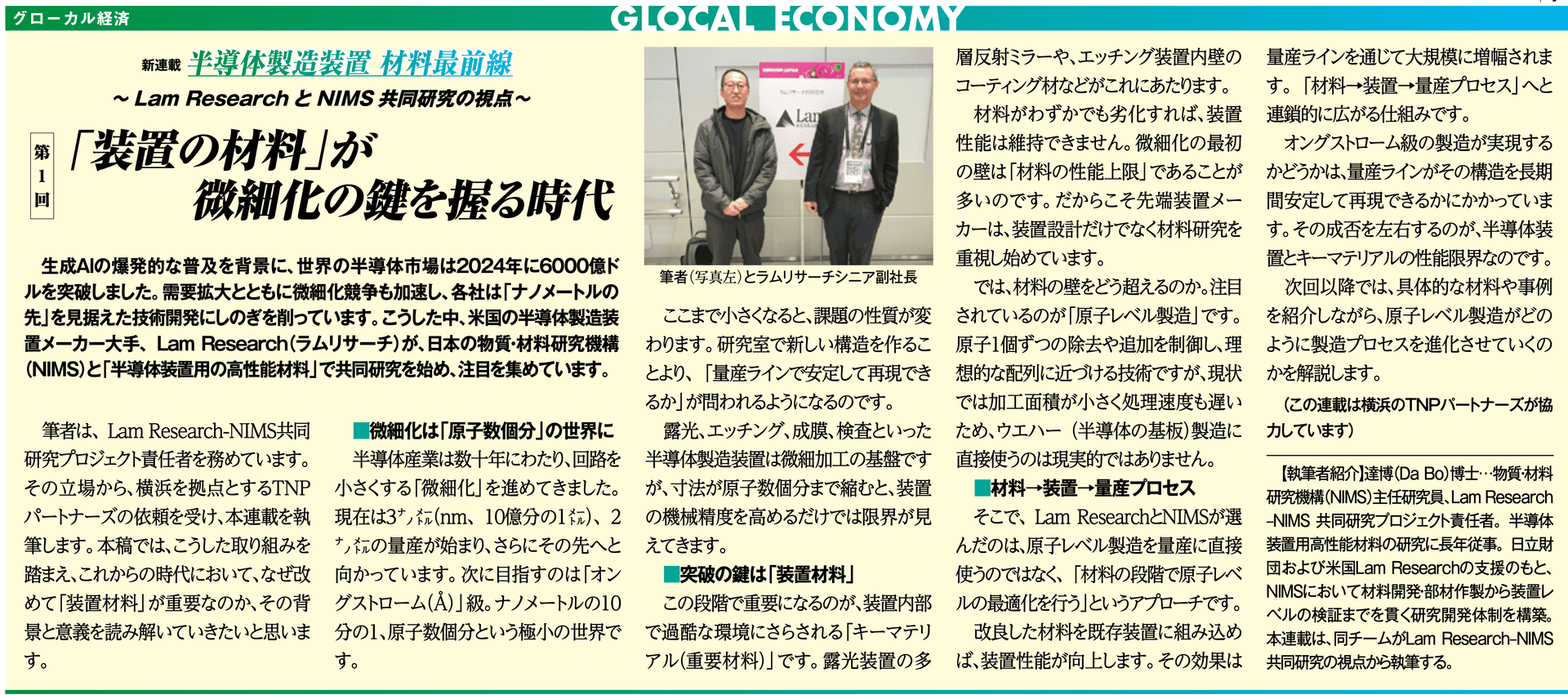
Driven by the explosive adoption of generative AI, the global semiconductor market exceeded $600 billion in 2024. As demand expands, the race for miniaturization accelerates, with companies fiercely competing in technological development aimed "beyond the nanometer." Amidst this, the joint research on "high-performance materials for semiconductor equipment" initiated by Lam Research, a major U.S. semiconductor manufacturing equipment maker, and Japan's National Institute for Materials Science (NIMS) has garnered significant attention. The author serves as the project leader for the Lam Research–NIMS joint research project. From this vantage point, and at the request of Yokohama-based TNP Partners, I have written this serialized column. In this article, drawing upon our initiatives, I aim to unravel the background and significance of why "equipment materials" are once again becoming crucially important in the coming era. ——Miniaturization Enters the Realm of "A Few Atoms" For decades, the semiconductor industry has advanced "miniaturization" to shrink circuits. Currently, the mass production of 3-nanometer (nm, one-billionth of a meter) and 2-nanometer nodes has begun, pushing even further ahead. The next target is the "Angstrom (Å)" class. This is an extremely microscopic world—one-tenth of a nanometer, equivalent to the size of just a few atoms . When dimensions shrink to this extent, the nature of the challenge shifts. Rather than just creating a new structure in a laboratory, the critical question becomes: "Can it be stably reproduced on a mass production line?" Semiconductor manufacturing equipment for lithography, etching, deposition, and inspection forms the foundation of microfabrication . However, as dimensions shrink to a few atoms, simply improving the mechanical precision of the equipment is reaching its physical limits. ——The Key to Breakthrough: "Equipment Materials" What becomes critical at this stage are the "key materials" exposed to the harsh environments inside the equipment. Examples include the multilayer reflective mirrors in lithography systems and the coating materials on the inner walls of etching chambers. If a material degrades even slightly, equipment performance cannot be maintained. The first hurdle in miniaturization is often the "performance limit of materials." This is exactly why advanced equipment manufacturers have begun prioritizing materials research just as much as equipment design. So, how do we overcome the materials barrier? "Atomic-level manufacturing" is currently drawing intense focus. It is a technology that controls the removal or addition of individual atoms to approach an ideal arrangement . However, at present, because the processing area is small and the speed is slow, it is not realistic to use it directly for wafer (semiconductor substrate) manufacturing. ——Materials → Equipment → Mass Production Process Therefore, the approach chosen by Lam Research and NIMS is not to apply atomic-level manufacturing directly to mass production, but rather "to perform atomic-level optimization at the materials stage." By incorporating these improved materials into existing equipment, the equipment's performance is enhanced. That effect is then amplified on a massive scale through the mass production line. It is a cascading mechanism that spreads from "Materials → Equipment → Mass Production Process." Whether Angstrom-class manufacturing becomes a reality depends on whether mass production lines can stably reproduce these structures over extended periods. The factors determining its success or failure are the performance limits of the semiconductor equipment and its key materials. In future installments, I will explain how atomic-level manufacturing will evolve the manufacturing process, introducing specific materials and case studies. (This series is supported by TNP Partners in Yokohama)
Breakthrough in Semiconductor Manufacturing Equipment:World's First Crystal for Precise Electron Beam Control
Regional Economic IntelligenceApril 2025

Breakthrough in Semiconductor Manufacturing Equipment:World's First Crystal for Precise Electron Beam Control

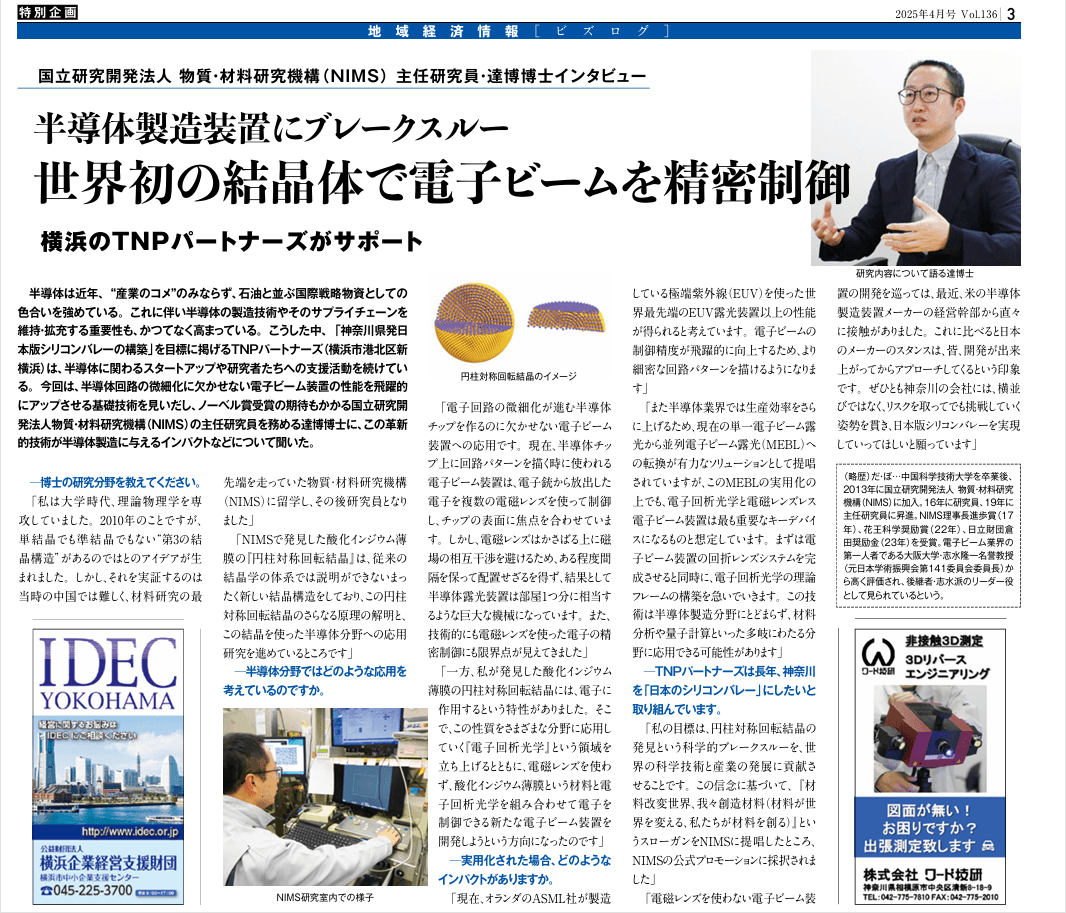
In recent years, semiconductors have increasingly taken on the character of an international strategic resource on par with oil, moving beyond their traditional role as the "rice of industry." Consequently, the importance of maintaining and expanding semiconductor manufacturing technologies and their supply chains is higher than ever. Against this backdrop, TNP Partners (Shin-Yokohama, Kohoku-ku, Yokohama), aiming to "build a Japanese version of Silicon Valley originating in Kanagawa Prefecture," continues to support semiconductor-related startups and researchers. For this feature, we interviewed Dr. Da Bo, Principal Investigator at the National Institute for Materials Science (NIMS), who is considered a promising candidate for a Nobel Prize. He has discovered a foundational technology that dramatically improves the performance of the electron beam equipment essential for miniaturizing semiconductor circuits. We asked him about the impact this innovative technology will have on semiconductor manufacturing. —— Could you tell us about your research field? "During my university years, I majored in theoretical physics. In 2010, I came up with the idea that there might be a 'third crystal structure' that is neither a single crystal nor a quasicrystal. However, it was difficult to prove this in China at the time, so I went to study at the National Institute for Materials Science (NIMS), which was at the forefront of materials research, and later became a researcher there." "The 'cylindrically symmetric rotational crystal' of indium oxide thin films that I discovered at NIMS has a completely new crystal structure that cannot be explained by conventional crystallographic systems. I am currently working on further elucidating the principles of this cylindrically symmetric rotational crystal and advancing applied research using this crystal in the semiconductor field." —— What kind of applications are you considering in the semiconductor field? "It is an application for electron beam equipment, which is indispensable for making semiconductor chips as electronic circuits become increasingly miniaturized. Currently, the electron beam equipment used to draw circuit patterns on semiconductor chips controls the electrons emitted from an electron gun using multiple electromagnetic lenses, focusing them on the surface of the chip. However, electromagnetic lenses are bulky, and to avoid mutual magnetic interference, they must be spaced apart to some extent. As a result, semiconductor lithography equipment has become a massive machine equivalent to the size of a room. Technologically, precision control of electrons using electromagnetic lenses is also reaching its limits." "On the other hand, the cylindrically symmetric rotational crystal of the indium oxide thin film that I discovered has the property of interacting with electrons. Therefore, along with establishing a new field called 'electron diffraction optics' to apply this property to various areas, we headed in the direction of developing a novel electron beam system that controls electrons by combining the indium oxide thin film material with electron diffraction optics, without using electromagnetic lenses." —— What impact will it have if it is commercialized? "I believe it can achieve performance surpassing the world's most advanced EUV (Extreme Ultraviolet) lithography equipment currently manufactured by ASML in the Netherlands. Because the control precision of the electron beam will dramatically improve, we will be able to draw much finer circuit patterns." "Furthermore, in the semiconductor industry, transitioning from current single electron beam lithography to multiple electron beam lithography (MEBL) is advocated as a strong solution to further increase production efficiency. We anticipate that electron diffraction optics and electromagnetic lens-less electron beam equipment will become the most critical key devices in commercializing this MEBL. First, we will urgently complete the diffraction lens system for the electron beam equipment while simultaneously constructing the theoretical framework for electron diffraction optics. This technology has the potential for applications not limited to semiconductor manufacturing, but extending to diverse fields such as materials analysis and quantum computing." —— TNP Partners has been working for many years to make Kanagawa the "Silicon Valley of Japan." "My goal is to have the scientific breakthrough of discovering the cylindrically symmetric rotational crystal contribute to the development of global science and technology and industry. Based on this belief, I proposed the slogan 'Materials change the world, and we create the materials' to NIMS, and it was adopted for their official promotion." "Regarding the development of electron beam equipment that doesn't use electromagnetic lenses, top executives from a U.S. semiconductor manufacturing equipment maker recently contacted me directly. In contrast, the stance of Japanese manufacturers gives the impression that they all wait to approach us until the development is fully completed. I sincerely hope that companies in Kanagawa will not just follow the crowd, but instead maintain a posture of taking on challenges even at a risk, to bring the Japanese version of Silicon Valley to life." Supported by TNP Partners in Yokohama