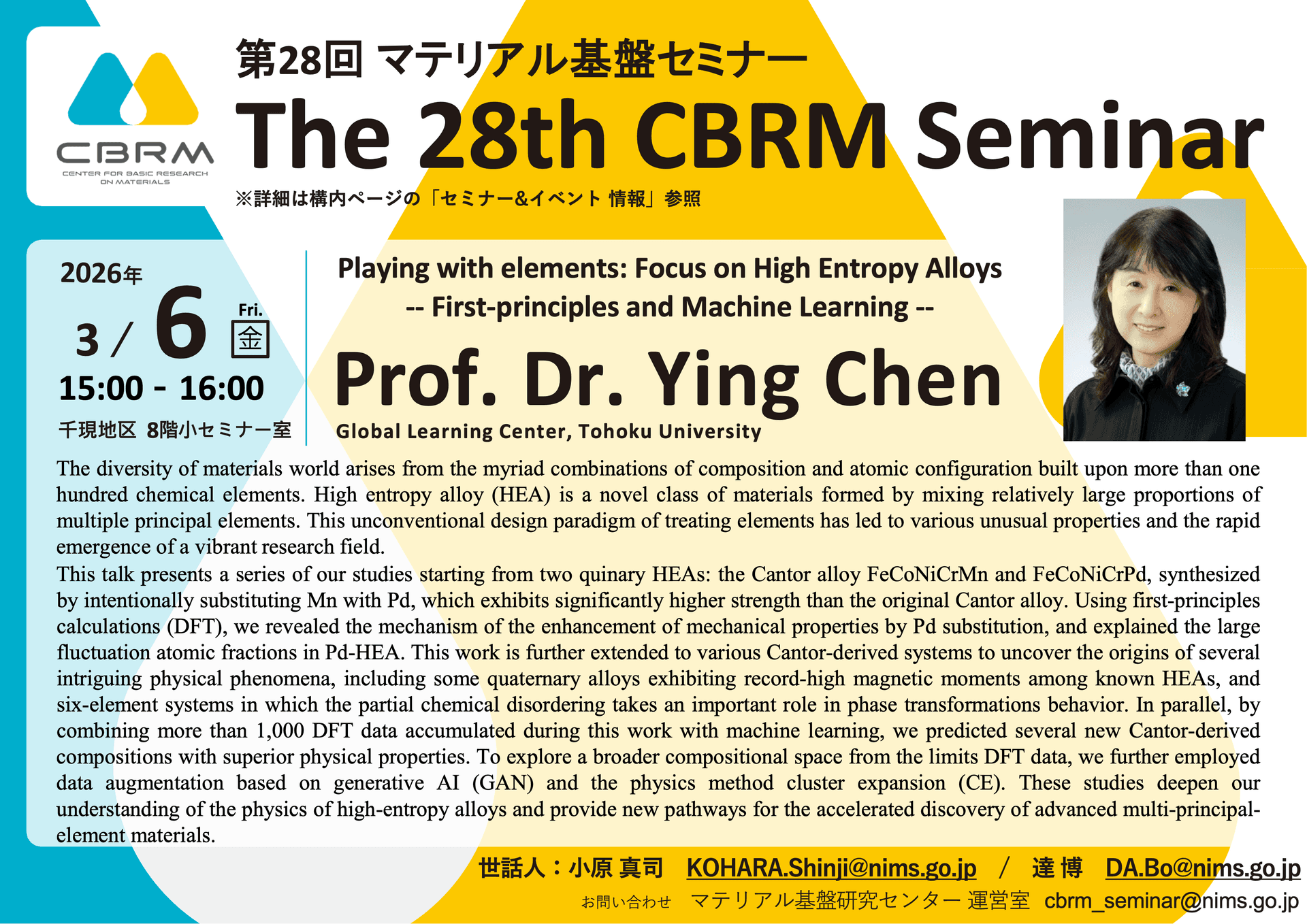
Playing with elements: Focus on High Entropy Alloys
First-principles and Machine Learning
Talk Video
Abstract
The diversity of materials world arises from the myriad combinations of composition and atomic configuration built upon more than one hundred chemical elements. High entropy alloy (HEA) is a novel class of materials formed by mixing relatively large proportions of multiple principal elements. This unconventional design paradigm of treating elements has led to various unusual properties and the rapid emergence of a vibrant research field.
This talk presents a series of our studies starting from two quinary HEAs: the Cantor alloy FeCoNiCrMn and FeCoNiCrPd, synthesized by intentionally substituting Mn with Pd, which exhibits significantly higher strength than the original Cantor alloy. Using first-principles calculations (DFT), we revealed the mechanism of the enhancement of mechanical properties by Pd substitution, and explained the large fluctuation atomic fractions in Pd-HEA. This work is further extended to various Cantor-derived systems to uncover the origins of several intriguing physical phenomena, including some quaternary alloys exhibiting record-high magnetic moments among known HEAs, and six-element systems in which the partial chemical disordering takes an important role in phase transformations behavior. In parallel, by combining more than 1,000 DFT data accumulated during this work with machine learning, we predicted several new Cantor-derived compositions with superior physical properties. To explore a broader compositional space from the limits DFT data, we further employed data augmentation based on generative AI (GAN) and the physics method cluster expansion (CE). These studies deepen our understanding of the physics of high-entropy alloys and provide new pathways for the accelerated discovery of advanced multi-principal-element materials.
Poster